


The Washington, DC area is more expensive than the average U.S. metro area. Households in the Washington-Arlington-Alexandria metro area spent an average of $108,215 a year in 2023 and 2024, compared with $77,907 nationally, according to the Bureau of Labor Statistics Consumer Expenditure Survey.
Housing accounts for a large part of that spending, but it is not the only cost to consider when planning a move to the area. Transportation, utilities, food, and taxes can vary considerably depending on where you live. JBG SMITH Living operates apartment communities in Washington, DC, Arlington, VA, and Bethesda, MD, so the sections below use those three jurisdictions to show how the same decision changes by location.
Housing
Housing was the largest household expense in the Washington area, averaging $35,402 a year in 2023 and 2024, according to the BLS Consumer Expenditure Survey.
That represented 32.7% of total household spending, slightly below the national average of 33.2%. The same BLS survey shows housing accounting for a smaller share of spending in Washington than in several other large metro areas, including Miami (40.0%), New York (38.2%), Los Angeles (36.6%), San Francisco (36.2%), and Boston (35.5%).
One reason is the difference in household income. In the same BLS data, average household income before taxes was $154,383 in the Washington area, compared with $103,012 nationally.
Housing costs also vary significantly within the region. An apartment in DC or Arlington may have a different monthly cost than a larger home in the Maryland or Virginia suburbs. The type of home matters as well. Apartments generally use less energy than detached homes, and residents who live near public transportation may have lower transportation expenses.
When comparing housing costs, it can be useful to consider these expenses together rather than looking at rent on its own. You can browse neighborhoods across the DC area to see how location factors into the total.
Utilities

Electricity costs in the District were lower than the national average in 2024. According to the U.S. Energy Information Administration, the average residential electric bill in DC was $113.23 per month, compared with $142.26 nationally. The averages were $165.87 in Maryland and $148.77 in Virginia.
The lower average bill in DC was not because electricity was less expensive. The average residential rate was 17.71 cents per kilowatt-hour in the District, compared with 16.48 cents nationally.
Instead, households in DC used less electricity. Average monthly consumption was 639 kilowatt-hours in the District, compared with 863 kilowatt-hours nationally.
The size and type of home can have a significant effect on energy use. An apartment with shared walls and less space to heat and cool will generally use less electricity than a detached home.
For example, an apartment at West Half, F1RST Residences, or 1221 Van in Navy Yard has less space to condition than a detached house in the outer suburbs, which is reflected in the monthly bill. When you tour, ask which utilities are included in the rent, since that changes the comparison between two apartments more than the rent figure alone suggests.
The EIA figures are from 2024, so they should be used as a reference rather than a current estimate. The BLS Consumer Price Index for the Washington area reported that the energy index increased 22.9% for the 12 months ending in July 2026.
When comparing apartments, check which utilities are included in the rent and which are billed separately.
Transportation
Transportation was another major household expense in the Washington area. According to the BLS Consumer Expenditure Survey, households spent an average of $17,149 a year on transportation, or 15.9% of total spending. The national average was 17.0%.
In the same BLS survey, private vehicles accounted for 85.3% of transportation spending in the Washington area, compared with 91.6% nationally.
For households that can rely on public transportation, walking, or biking, transportation costs can be lower. AAA's most recent Your Driving Costs study estimated the average annual cost of owning and operating a new vehicle at $11,577. That figure includes depreciation, financing, fuel, insurance, maintenance, and registration.
A WMATA Monthly Unlimited Pass costs between $72 and $216, depending on the length of the typical trip. That works out to $864 to $2,592 per year. Metrorail fares range from $2.25 to $6.75, while local Metrobus service costs $2.25.
Whether it makes sense to go without a car depends largely on where you live and where you need to go. Neighborhoods with convenient access to Metro, bus routes, bike infrastructure, and everyday services make it easier to use a car less often. Our guide to car-free neighborhoods in the DC metro covers this in more detail.
National Landing in Arlington is one example. RiverHouse, 220 Twentieth Street, The Grace, Reva, The Zoe, Valen, and The Bartlett are all located near Metrorail, bus service, and protected bike connections, which is what makes reducing or dropping a car realistic rather than theoretical. The Bartlett anchors the north end of the neighborhood.

For anyone comparing apartments, it can be helpful to include transportation costs in the housing decision. A higher rent may come with lower transportation expenses if it allows you to use a car less frequently or go without one altogether.
Groceries and dining
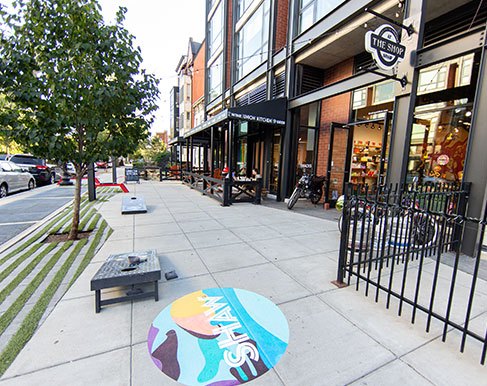
For a relocation budget, it can be useful to estimate both grocery spending and dining out rather than treating food as a single expense.
Income taxes
The Washington metropolitan area spans three tax jurisdictions: the District of Columbia, Maryland, and Virginia. Each has a different income-tax structure.
Virginia has a state income tax but does not impose a local income tax. Maryland has a state income tax as well as county income taxes. Montgomery County, which includes Bethesda, has a local income-tax withholding rate of 3.20% for 2026, according to the Comptroller of Maryland. The District has its own graduated income-tax brackets.
The amount you actually pay depends on factors including income, filing status, and deductions. Tax rates and brackets can also change, so current information should be checked with the Virginia Department of Taxation, the Comptroller of Maryland, and the DC Office of Tax and Revenue.
Taxes are worth considering when comparing housing costs across the region. Two households with the same gross income may have different take-home pay depending on where they live. If you are weighing an Arlington apartment against one in DC or against 8001 Woodmont in Bethesda, the difference belongs in the comparison alongside rent.
JBG SMITH Living communities across the DC area
The costs above are easier to compare when you can look at the same operator in all three jurisdictions.
In Arlington, VA, National Landing includes RiverHouse, 220 Twentieth Street, The Grace, Reva, The Zoe, Valen, and The Bartlett. Virginia does not levy a local income tax, and these communities sit near Metrorail, bus routes, and protected bike connections.
In Washington, DC, Navy Yard includes West Half, F1RST Residences, and 1221 Van. Shaw includes Atlantic Plumbing, The Wren, and 901W. The Union Market and Eckington area includes The Batley and Judd & Weiler at Quincy Lane.
In Bethesda, MD, 8001 Woodmont is in downtown Bethesda near Bethesda Row and the Capital Crescent Trail.
When you compare specific apartments, ask each community which utilities are included in the rent, what monthly parking costs if you plan to keep a car, and what is within walking distance. Those three answers account for most of the difference between two apartments that list similar rents.
Questions about the cost of living in Washington, DC
Is the Washington, DC area more expensive than other major U.S. metros?
Average household spending in the Washington-Arlington-Alexandria metro area was $108,215 in 2023 and 2024, compared with $77,907 nationally, according to the BLS Consumer Expenditure Survey.
In the same BLS data, housing accounted for 32.7% of household spending in Washington, which was lower than the share in several other large metro areas, including Miami, New York, Los Angeles, San Francisco, Boston, and Seattle.
How much should I budget for utilities in a DC-area apartment?
According to the U.S. Energy Information Administration, the average residential electric bill in the District was $113.23 per month in 2024, compared with $142.26 nationally. Maryland and Virginia averaged $165.87 and $148.77, respectively.
These figures are from 2024, and energy costs have increased since then. Your actual utility costs will depend on the size of your apartment, the building, the season, and your usage.
Ask the apartment community which utilities are included in the rent and which ones you will pay separately.
Do I need a car in the DC metro area?
Not necessarily. It depends on where you live and how you travel.
AAA’s most recent Your Driving Costs study estimated the average annual cost of owning and operating a new vehicle at $11,577. A WMATA Monthly Unlimited Pass costs between $72 and $216, depending on the typical trip length.
If you live near Metro or frequent bus routes and have easy access to the places you visit regularly, you may be able to reduce your transportation costs by using a car less often or going without one.
Travel by bicycle is the most affordable way around town, and the DC Metro area is also well outfitted with cycling trails that criss-cross the District and reach deep into Maryland and Virginia. The Capital Crescent Trail connects Bethesda to Georgetown. The WO&D Trail runs from Arlington all the way to Leesburg. This network of trails benefits all sorts of cyclists. Adventure out to George Washington’s home on the Mount Vernon Trail. Race laps around Haines Point with the road cyclists. Commute through Rock Creek, Sligo Creek, the Metropolitan Branch Trail, or the Anacostia River Trail to get to and from work safely and simply.
Is it cheaper to live in DC, Virginia, or Maryland?
There is no single answer. Housing costs, transportation expenses, and income taxes all vary across the region.
Virginia does not have a local income tax, while Maryland counties impose their own income taxes. The District has its own graduated income-tax brackets. Current rates are published by the Virginia Department of Taxation, the Comptroller of Maryland, and the DC Office of Tax and Revenue.
When comparing apartments, consider your expected take-home pay and your other monthly expenses in addition to rent.
Planning your cost of living
The best way to estimate the cost of living in the Washington, DC area is to build a budget around the location and apartment you are considering.
Start with rent, then add utilities, transportation, parking if needed, groceries, dining, and other regular expenses. If you are comparing an apartment in Arlington with one in DC or Bethesda, consider how the location will affect your transportation and tax costs as well.
Search available JBG SMITH Living apartments across Arlington, DC, and Bethesda to compare floor plans, pricing, and availability side by side.


